Kitchen
Kitchen Peninsula vs Island (Pros, Cons & How To Choose)
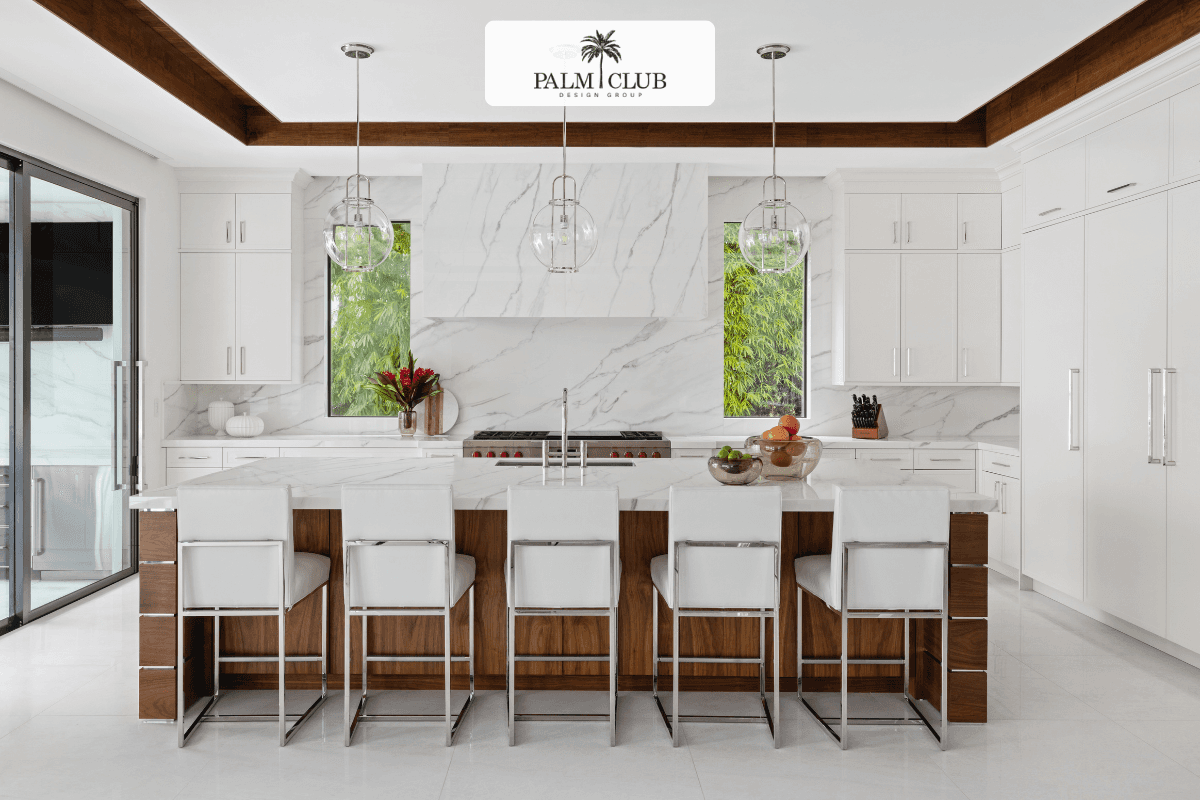
Some kitchens feel open and effortless.
Others feel tight, even when they’re beautifully finished.
More often than not, the difference comes down to layout.
Choosing between a kitchen peninsula vs island shapes how people move, where they gather, and how comfortably the space supports daily routines.
It’s a decision that influences circulation, storage, seating, and construction complexity all at once. We’ll break down how each option works and how to choose the right fit for your remodel.
Key Notes
Proper clearances, not preference, determine island or peninsula success.
Islands require 42–48 inches clearance to function comfortably.
Peninsulas maximize storage in tighter L- and U-shaped kitchens.
Quick Answer: Kitchen Peninsula or Island?
In a kitchen peninsula vs island decision, the “best” answer usually comes down to three things:
clearances
circulation
and how loaded you want the center of the kitchen to be
Choose a kitchen island when…
You can comfortably maintain 42–48 inches of working clearance on all sides and you want a central hub with 360° access.
Choose a kitchen peninsula when…
An island would squeeze circulation, or when you want island-like counter and seating while keeping services and structure simpler.
Choose neither when…
Adding any center block would create pinch points, block appliance doors, or force your main traffic route through the cook zone.
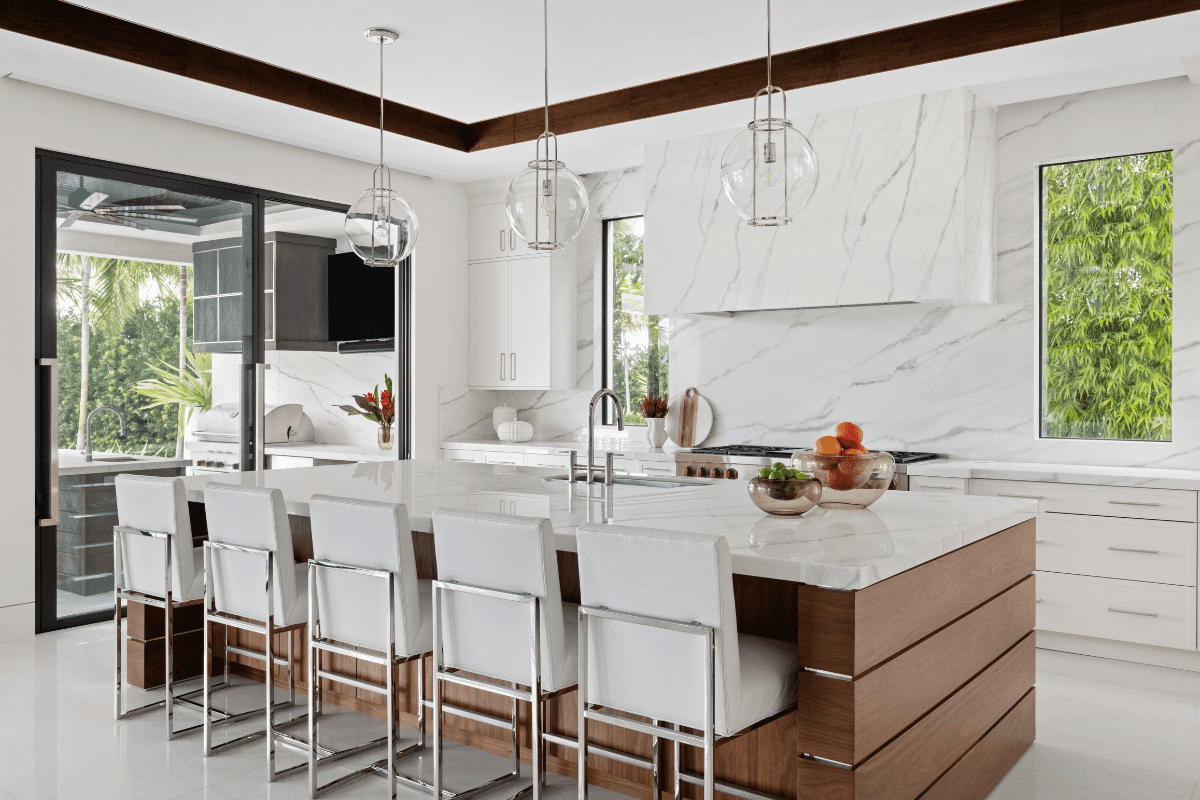
What’s The Difference Between A Kitchen Island And A Kitchen Peninsula?
The core difference between a kitchen island and a kitchen peninsula is simple, but it changes everything about:
traffic
workflow
and how the room feels
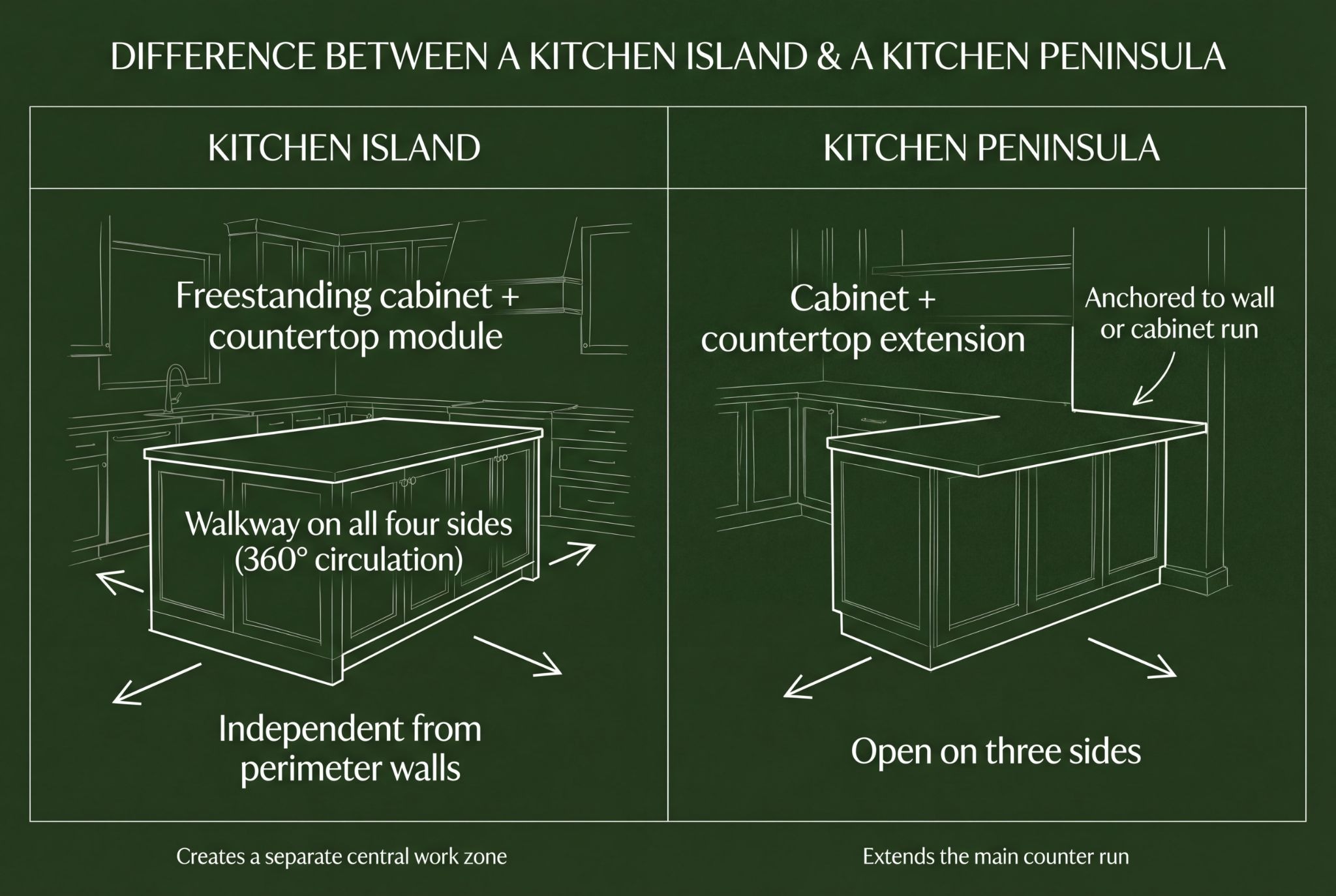
In other words: an island “floats,” a peninsula “reaches.”
The Real Decider: Space, Clearances, Door Swings
If you take nothing else from this guide, take this: most kitchen peninsula vs island problems are clearance problems.
You can “fit” almost anything on paper.
The question is whether it will be comfortable when:
the dishwasher is open
the fridge door is wide
two people are cooking
someone is seated at the counter
a kid runs in for a snack
Kitchen Island Clearances That Make Or Break The Plan
For a true working island, plan:
42 inches clear on all sides as a baseline
48 inches if two people cook, or if appliances open into that aisle
You’ll see 36 inches quoted as an absolute minimum. It can technically work, but it behaves more like a hallway than a comfortable work aisle.
And if you want seating, you typically need closer to 44–48 inches behind stools so someone can pass while others are seated.
Kitchen Island Size & Room Size
A common “small” fixed island is around 4 ft x 2 ft.
Average islands are often closer to 3 ft x 6.5 ft.
Put that together with clearance requirements, and you can see why many designers land around a minimum kitchen footprint of roughly 10 ft x 10 ft to make a fixed island workable.
Bigger is noticeably better.
Kitchen Peninsula Clearances Where They Matter Most
A kitchen peninsula usually needs the same clearance guidelines, but only on the open sides and especially at the “turn” where you enter the U.
Peninsulas funnel traffic. That’s not automatically bad.
It just means you have one opening that has to be sized correctly, or the kitchen becomes a daily bottleneck.
The Door Swing Audit
Before choosing kitchen island vs peninsula, do a quick door swing audit:
Can the dishwasher open fully without blocking the only path through?
Can the oven door drop without hitting someone’s knees at seating?
Can the fridge door open wide enough to pull drawers without being trapped by the island?
Will pantry doors and adjacent hallway doors clash with the island edge?
If your layout fails the door swing audit, it’s not “a little tight.”
It’s a design problem you’ll feel every single day.
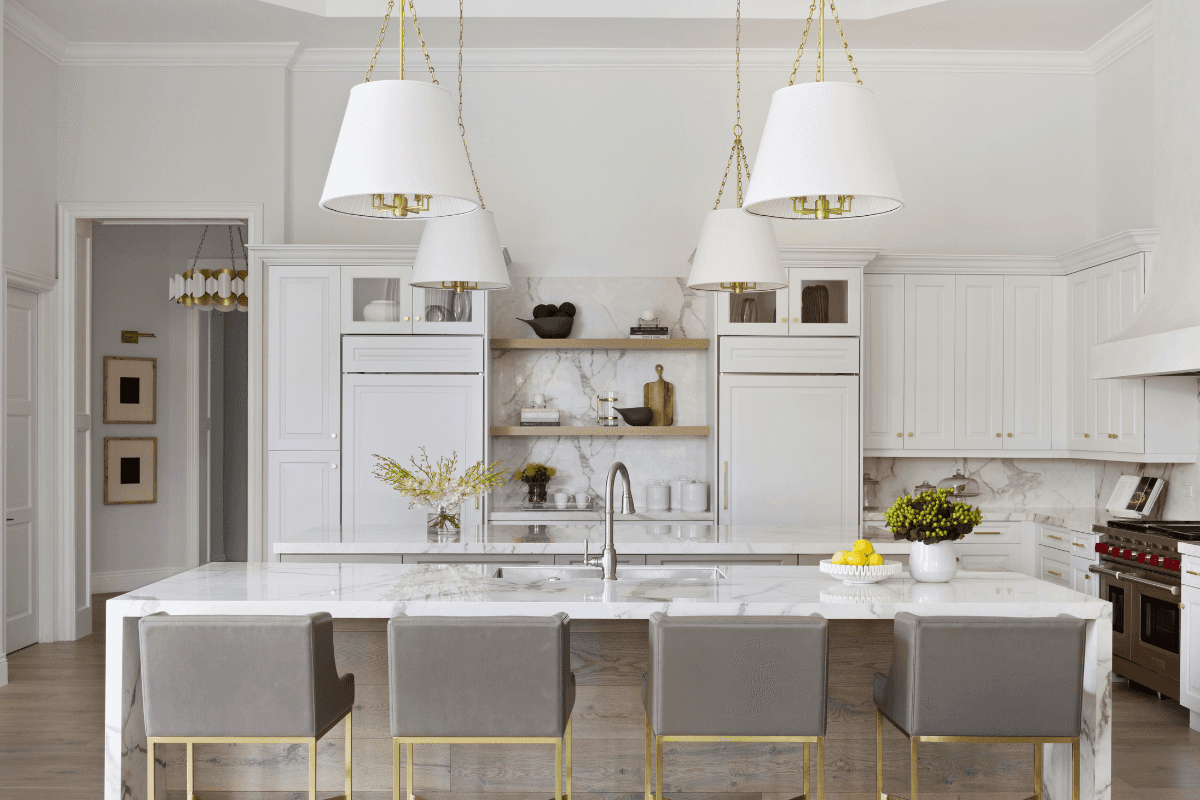
Traffic Flow & Daily Usability: Kitchen Island vs Peninsula
Traffic flow is where kitchen peninsula vs island choices show their personality.
Kitchen Island Traffic Flow
A kitchen island gives you 360° circulation. People can pass on either side and create multiple routes through the kitchen and to adjacent rooms.
When the clearances are right, an island tends to spread people out.
You don’t get a single choke point.
Most island congestion happens when:
the island is oversized for the room
it’s too close to a wall run
it blocks the direct path from the garage entry to the fridge
Kitchen Peninsula Traffic Flow
A peninsula funnels traffic into an L- or U-shaped path.
That can create tighter choke points, but it also creates more predictable movement.
This is why some households prefer a peninsula. It keeps guests on the “outer side” and keeps the cook zone more contained.
The downside is obvious – if someone is standing at the opening, or if stools are too close, the whole kitchen can feel blocked.
Rule Of Thumb:
Islands usually reduce jams when you have space.
Peninsulas can either control traffic nicely or create a daily pinch point depending on that opening.
Kitchen Island Pros and Cons
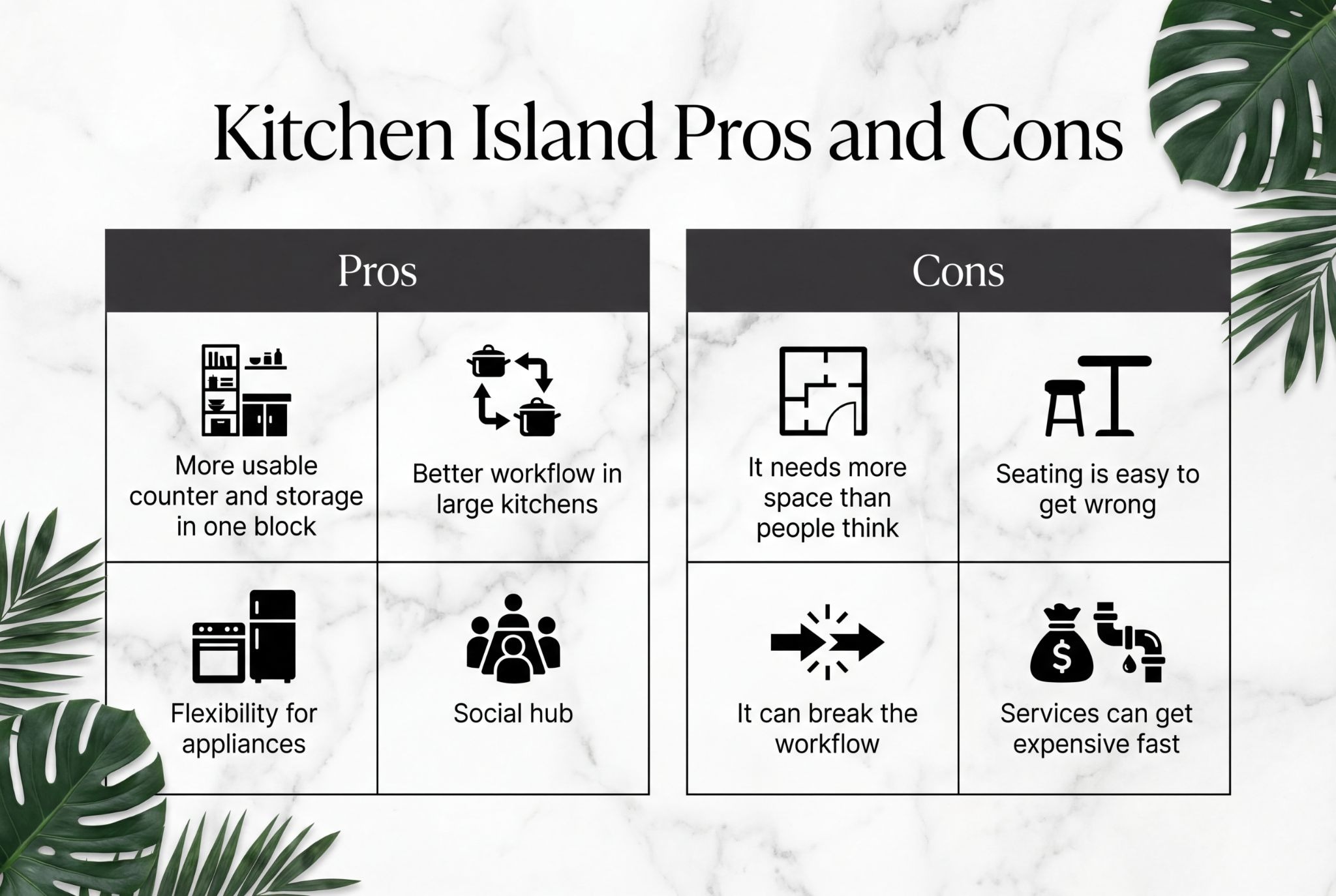
The big picture kitchen island benefit is that it gives you a central, multi-sided workstation that also acts as the social anchor of the kitchen.
Kitchen Island Pros
More usable counter and storage in one block. A well-designed island can offer drawers and cabinets on multiple faces, including end storage.
Better workflow in large kitchens. In spread-out rooms, a kitchen island can bridge the gap between runs and create a more efficient prep zone.
Flexibility for appliances. A kitchen island can host a prep sink, a main sink, a dishwasher, a microwave drawer, or an under-counter fridge, assuming the room and budget support it.
Social hub. You can cook while facing family or guests instead of a wall. In open plans, the island quietly zones the kitchen from dining and living while keeping sightlines open.
Kitchen Island Cons
It needs more space than people think. Clearances are not optional. Tight aisles lead to door clashes and constant bottlenecks.
Seating is easy to get wrong. Overhang, stool spacing, and clearance behind stools matter. If people can’t push back and someone can’t pass behind them, the seating won’t get used.
It can break the workflow. Islands look right on paper and still disrupt the work triangle if placement is off.
Services can get expensive fast. As soon as you add water, gas, or a cooktop, a kitchen island becomes a services hub.
Kitchen Peninsula Pros and Cons
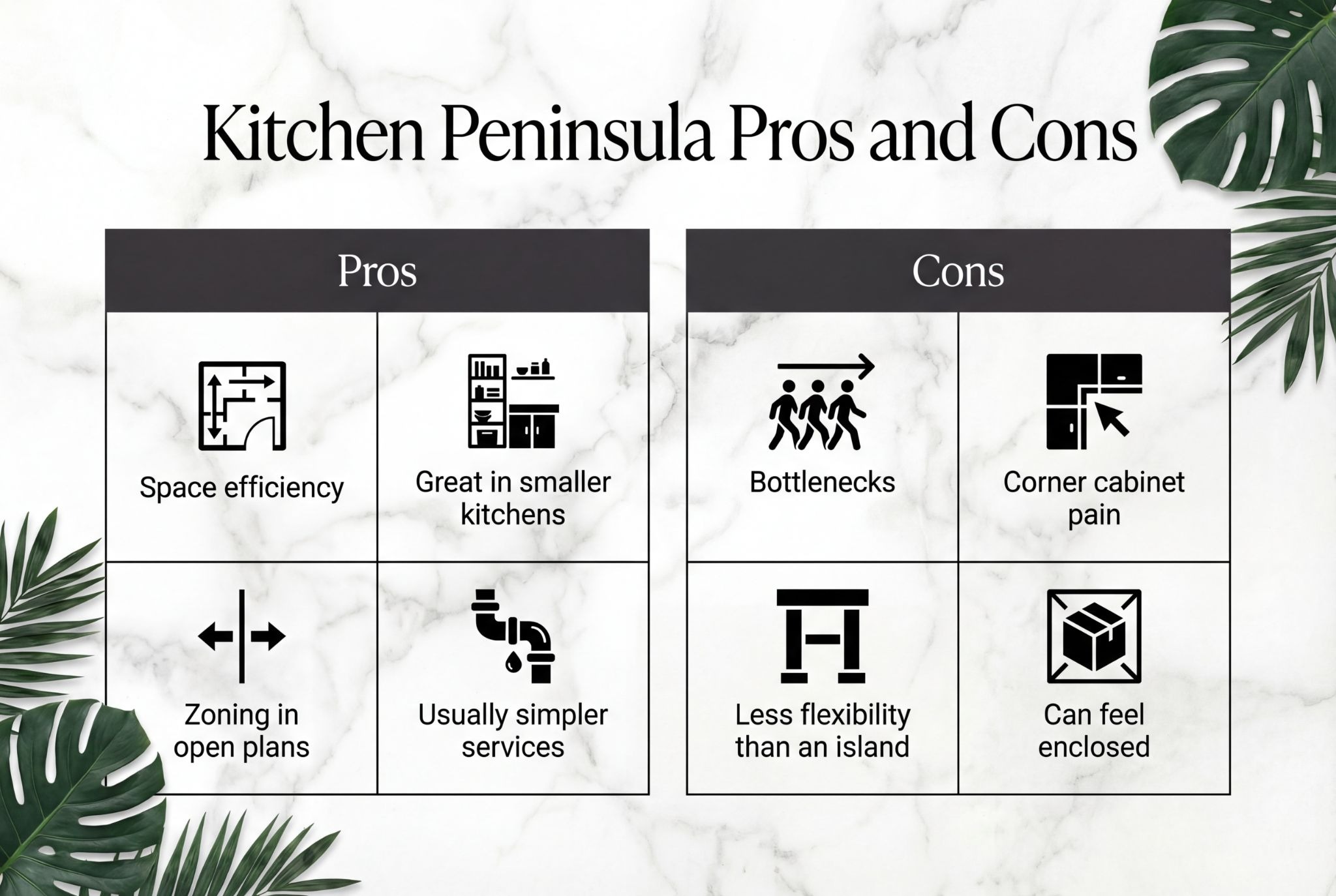
A kitchen peninsula’s biggest strength is that it gives you island-like function while piggybacking on existing walls.
That makes it more space-efficient and often simpler and cheaper to integrate.
Kitchen Peninsula Pros
Space efficiency. Because one end is attached, what would have been a circulation path becomes more continuous counter.
Great in smaller kitchens. In an island or peninsula in small kitchen scenario, peninsulas often win because they add storage and surface without demanding 360° circulation.
Workflow-friendly in L and U layouts. A peninsula can turn a one-wall or L kitchen into an efficient U, tightening the primary triangle and keeping through-traffic out.
Zoning in open plans. A peninsula can act like a subtle half wall, defining the kitchen edge while keeping views open.
Usually simpler services. If you add a sink or dishwasher, you can often tie into nearby services through the attached wall side rather than trenching into the middle of the room.
Disadvantages Of A Peninsula Kitchen
Bottlenecks. A peninsula often leaves one main way in and out. If that opening is tight, people end up shuffling past each other.
Corner cabinet pain. The inside corner where the peninsula meets the main run is notorious for hard-to-reach base cabinets and dead counter zones.
Less flexibility than an island. You only access it from three sides. Seating layouts are more limited.
Can feel enclosed. In very open architecture, a peninsula can make the kitchen feel more boxed in if it over-divides the space.
Best Layout Matches: Island vs Peninsula Kitchen Layout
L-Shaped Kitchens
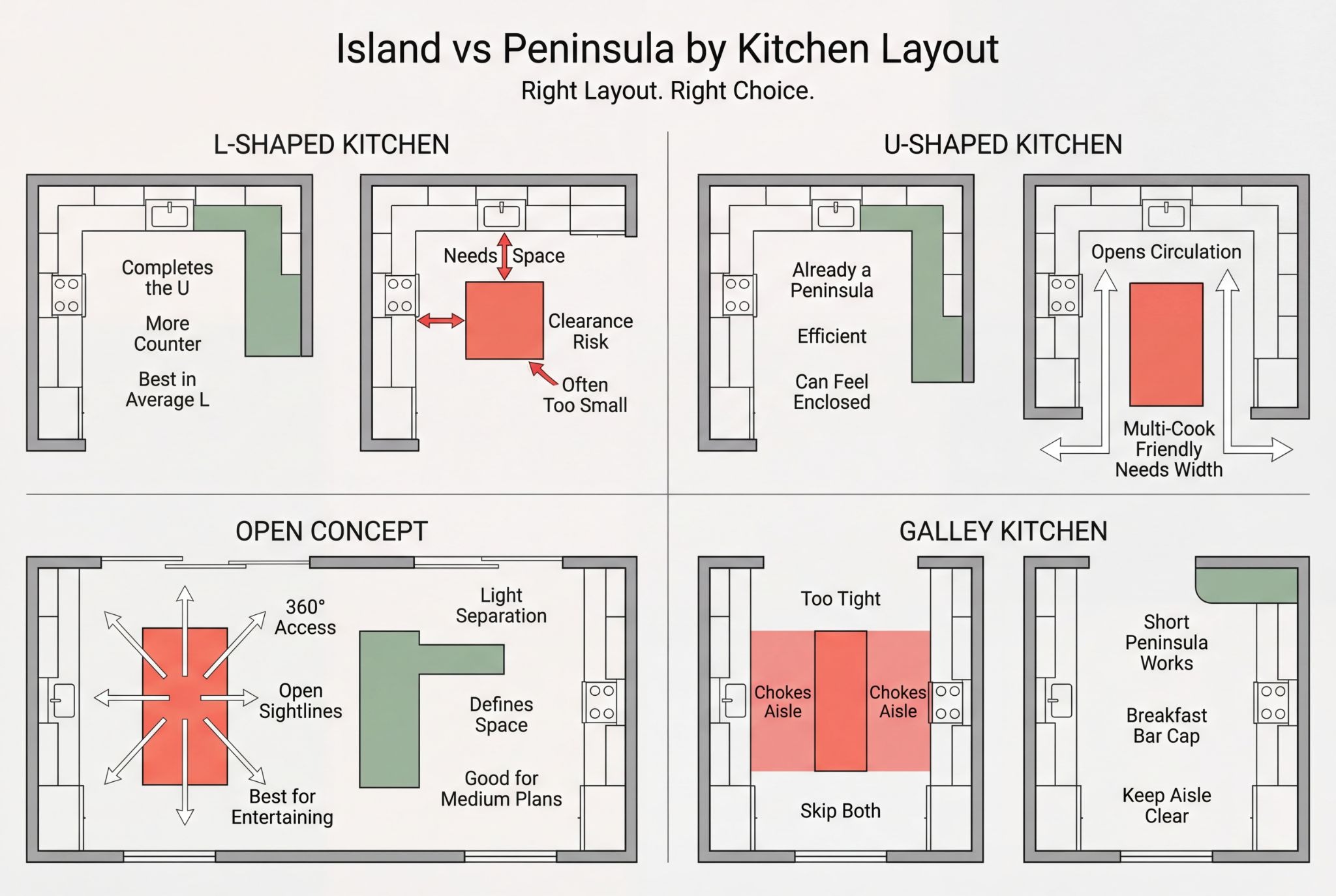
In typical L-shaped rooms, a peninsula often works better because it completes the L into a U, maximizing counter and storage without needing full circulation around an island.
Islands can work in a large L, but in average L-shaped kitchens they either squeeze clearances or end up too small to be worth it.
U-Shaped Kitchens
Many U-shaped kitchens already function as peninsula kitchens.
Efficient, but sometimes enclosed.
In wider U-shaped spaces, removing one leg and adding an island can improve circulation and let multiple people work without trapping the cook.
Open-Concept Floor Plans
Islands usually win because they keep sightlines open and give 360° access.
Peninsulas are useful in smaller or medium open plans when you want a bit more separation without building a full wall.
Galley Kitchens
True narrow galleys often do best without either.
Adding an island or peninsula can choke the main aisle.
In wider walk-through galleys, a short peninsula at one end can work as a cap and breakfast bar.
Seating & Entertaining: Kitchen Peninsula vs Island
When A Kitchen Island Is Better For Seating
A kitchen island can seat more people and on more than one side. That makes it feel more social, less like everyone is lined up at a bar.
If you entertain often, an island usually works better because guests can circulate around without pinning the cook into a corner.
When A Kitchen Peninsula Is Better For Seating
In smaller kitchens, a kitchen peninsula is often more comfortable and realistic. It can seat 2–3 without sacrificing the circulation you need to actually cook.
A peninsula can also feel more “table-like,” especially if you pair it with a banquette.
The Seating Math You Should Not Skip
If you want seating, plan:
enough width per stool so elbows aren’t constantly touching
enough overhang for knees and legroom
enough clearance behind seating for someone to pass
Storage & Functionality
In a big enough room, an island often wins on raw storage volume.
In tighter rooms, a peninsula can net more usable storage because you’re not “wasting” space on circulation around all four sides.
Kitchen Island Storage
A full island can have cabinets or drawers on multiple sides.
In larger islands, you can do back-to-back storage and end drawers.
Kitchen Peninsula Storage
A peninsula adds a full run of base cabinets and continuous counter without requiring 360° aisles.
In small and medium kitchens, that can be a better return on space.
Simple rule:
Large kitchen with room to walk all around, island storage potential is higher.
Smaller kitchen with tight clearances, peninsula storage is often more efficient.
Cost & Build Complexity: Is A Peninsula Better Than An Island?
A kitchen island is usually more expensive than a peninsula because:
all four sides must be finished
islands more often include plumbing, electrical, and sometimes ventilation
installation is more complex because it’s freestanding
A kitchen peninsula is often cheaper because:
it shares structure with the run it attaches to
it usually needs fewer finished faces
services can often extend from the attached wall side
If you’re making a decision based on budget and simplicity, a peninsula often wins.
If you’re making a decision based on openness, circulation, and a central social hub, an island often wins.
Is A Kitchen Peninsula Outdated?
A kitchen peninsula isn’t inherently outdated.
Peninsulas got labeled “dated” because a lot of older homes had chunky, raised-bar peninsulas that blocked sightlines and felt like a wall.
A modern peninsula looks intentional when:
heights align cleanly
overhang and seating are proportioned properly
panels and leg details match the cabinetry
lighting and sightlines stay open
A peninsula will feel dated when it over-divides an open plan or looks tacked on with mismatched thicknesses and awkward corners.
Common Planning Mistakes (& How to Avoid Them)
Kitchen Island Mistakes
Squeezing it in with too little clearance
Making it too big or too small for the room
Dropping it directly in the middle of the work triangle
Overloading it with sink + hob + seating + storage so none of it feels great
Forgetting outlets and lighting planning
Kitchen Peninsula Mistakes
Making the opening into the U too narrow
Creating a corner cabinet situation that wastes storage
Adding seating that blocks the only route in and out
Letting it visually chop up the space
Finishes that don’t align so it looks like an afterthought
When Neither An Island Nor A Peninsula Makes Sense
There are kitchens where adding anything in the middle hurts function more than it helps.
Neither makes sense when:
the room is too narrow to keep about 36 inches of continuous walkway on both main sides
a primary circulation route must cut straight through the kitchen
appliance doors would constantly clash
a true galley works well now and a new leg would break its strength
In Those Cases, Better Options Often Include:
maximizing wall runs and tall storage
improving landing zones near the fridge and sink
using a movable cart that can be pulled out when needed
Decision Checklist: Choose Kitchen Peninsula vs Island
Use this checklist to decide without overthinking it:
Space & Clearances
Can you maintain 42–48 inches around a freestanding island?
If not, lean peninsula.
Traffic Routes
Does anyone need to cut through the kitchen to reach key areas?
If yes, an island may reduce bottlenecks if sized correctly.
Cooking Style
Two cooks, frequent entertaining, and multi-tasking kitchens tend to favor islands.
Smaller households and contained cook zones tend to favor peninsulas.
Seating Reality
If seating blocks the only route, rethink the seating.
Storage Priorities
Big room: island storage can be massive.
Tight room: peninsula storage is often more efficient.
Services Tolerance
Want sink, cooktop, dishwasher in the center? Expect complexity and cost.
Want simple, cheaper service routing? Peninsulas usually win.
Planning A Remodel & Stuck On Layout?
Start with design, scope, and budget aligned correctly.
Frequently Asked Questions
Can you have both a kitchen island and a peninsula?
Yes, but only in larger kitchens with generous clearances. In most homes, adding both creates congestion unless the layout is carefully engineered to maintain proper working aisles and circulation paths.
Does a kitchen island add more resale value than a peninsula?
Not automatically. Buyers respond more to functionality and flow than the label. A well-proportioned peninsula in the right room will outperform a cramped island every time.
Which option is better for wheelchair or walker accessibility?
An island with wide, continuous clearances typically performs better for accessibility because it allows multiple routes around the kitchen. Peninsulas can work, but the opening into the U must be generously sized.
Can a peninsula feel as modern as an island?
Absolutely. Clean proportions, aligned cabinet detailing, and integrated seating make a peninsula look intentional and contemporary. What dates a space is bulk and poor alignment, not the layout type itself.
Conclusion
Choosing between a kitchen peninsula vs island is a circulation, clearance, and construction decision.
A kitchen island works beautifully when you truly have the room for 42 to 48 inches of working space on all sides and want a central hub that supports seating, prep, and open movement. A kitchen peninsula earns its place when space is tighter, services need to stay near walls, and you want to maximize storage without sacrificing flow.
The right answer is the one that works when the dishwasher is open, the fridge is wide, and real life is happening around you.
If you’re planning a remodel and want layout, scope, and budget aligned before anything is built, book a free discovery call. We’ll walk your space with you and help you make the right decision before it becomes an expensive one.


Thinking About a remodel?