Contractor Coordination
Construction Punch Lists Explained

A construction punch list is the most useful document you'll barely hear about until your remodel is almost over.
Used well, it's how you confirm the work is genuinely complete and hold your contractor to the design you approved. Used poorly, or skipped, it becomes a year of follow-up emails.
We’ll cover what it is, what belongs on it, who owns each part, and how to walk your home to build one.
Key Notes
A punch list covers incomplete work, defects, and deviations from the approved design.
Items raised before move-in are the contractor's obligation; afterward, they're harder to enforce.
Walk every space slowly before handover and document each item in writing.
What Is A Construction Punch List?
A construction punch list is the written record of outstanding work that a homeowner and contractor agree must be completed or corrected before a remodel is signed off.
It's the catalog of everything standing between a home that looks done and one that is done.
What Goes On A Construction Punch List?
A construction punch list captures every item that falls short of the approved design, the contract, or basic finish quality. To build a complete one, it helps to think in three distinct categories, because each gets missed for a different reason.
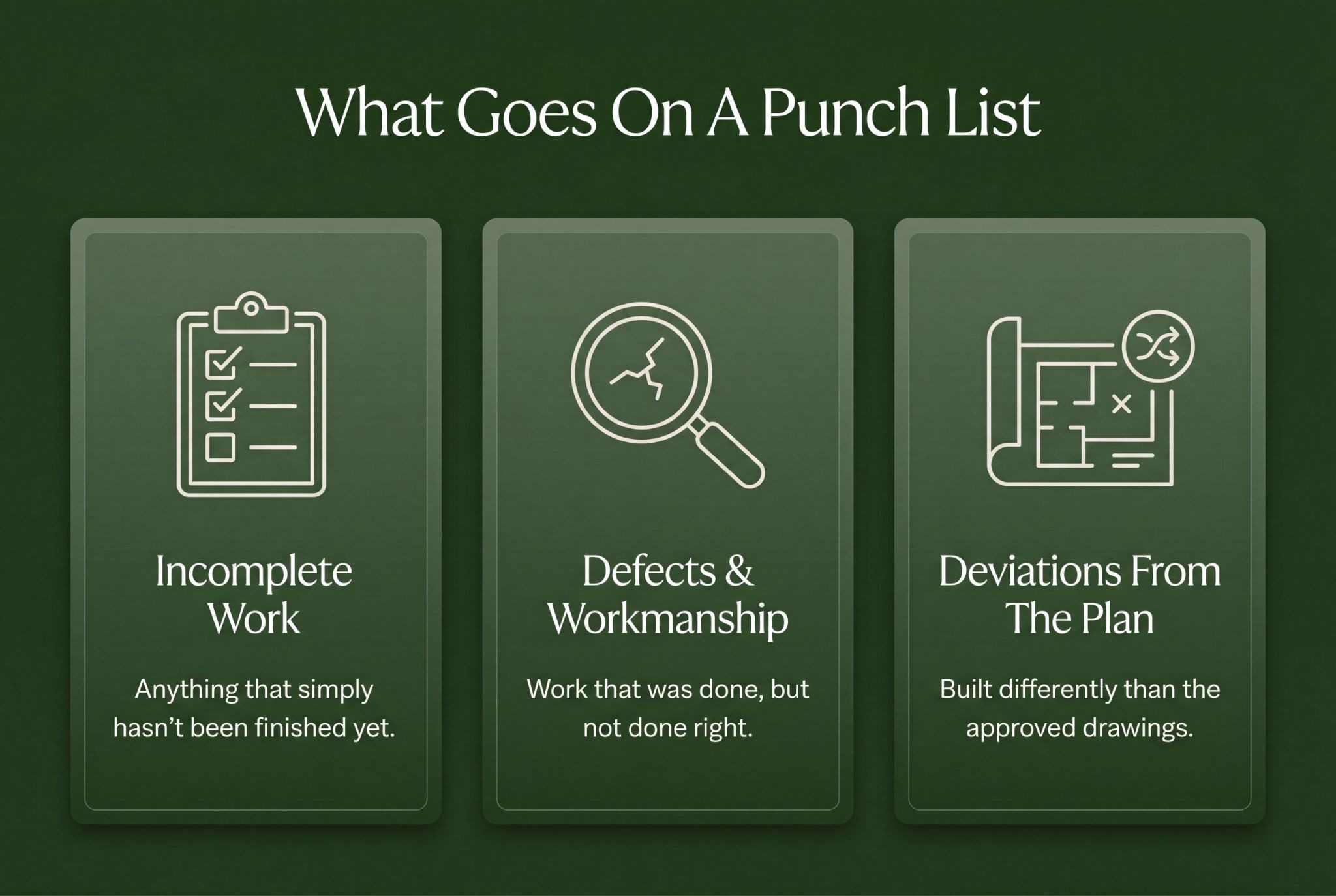
Incomplete Work…
Is anything that simply hasn't been finished yet:
Missing hardware, trim, or hardware covers
Edges, transitions, or seams left unsealed
Touch-up painting or areas never painted
Fixtures installed but not adjusted or tested
Defects & Workmanship Issues…
Are things that were done, but not done right:
Chips, scratches, or damage to finished surfaces
Uneven grout lines, lippage in tile, or poor caulking
Doors and drawers that don't sit or close correctly
Cosmetic flaws in cabinetry, stone, or millwork
Deviations From The Approved Drawings And Specifications…
Are the hardest category for an untrained eye to catch:
Materials that were substituted somewhere along the way
Tile patterns or layouts that got simplified during install
Fixtures or outlets placed differently than drawn
Design details that were "interpreted" rather than executed
Who Is Responsible For The Construction Punch List?
Responsibility for a construction punch list is shared across a few parties, and knowing who owns which part is what keeps the end of a project from turning into a standoff.
The roles break down cleanly:
Role | What They Own |
Homeowner | Walking the space, identifying items, and agreeing the final list in writing |
General contractor | Executing all corrective work and completing every documented item |
Owner's representative (when involved) | Generating the list, prioritizing items, and tracking each one through to resolution |
Splitting Up Punch List Responsibility
The homeowner and contractor build and agree the list together – it should be a written document both parties sign, not a verbal understanding or a few texts.
The general contractor owns the fixes. They're the one who built the project, and the corrective work is theirs to complete.
Where an owner's representative is part of the project, they sit on your side of the table, documenting the list and holding the contractor accountable until every item is closed out.
The Reason This Matters:
Ambiguity over who owns what is one of the most reliable ways for costs and unfinished work to slip through the cracks at closeout.
A clearly owned punch list removes that ambiguity before it becomes a dispute.
Why Move-In Timing Decides Whether Your Punch List Holds
The single most important thing to understand about a construction punch list comes down to one decision: when you move back in.
That timing, more than the length or detail of the list itself, decides whether you can get the work resolved.
Before s. After Move-In Changes Everything:
Items raised before you move back in are the contractor's clear obligation. The project isn't closed, you haven't accepted the work, and they're still on the hook to make it right.
Items raised after you've settled in are harder to enforce. The contractor can reasonably argue the issue is wear or your own doing, and some items may fall outside warranty coverage entirely.
The Warranty Wrinkle:
Work and materials installed by your contractor generally fall under their responsibility through the punch list and any agreed warranty period. Items you sourced yourself are usually yours to pursue directly with the supplier.
Settling in before the list is closed blurs that line in the contractor's favor, not yours.
How To Walk Your Home And Build A Complete Construction Punch List
Building a thorough construction punch list starts with walking every space alongside your contractor before final handover.
Walk it slowly, room by room, with one job in mind: find what's wrong.
A Few Principles Make The Walk Useful:
Go room by room, methodically. Check finishes, fixtures, and function in every space, including the ones you're least excited about. Closets, laundry rooms, and powder rooms are where rushed work hides.
Test things, don't just look at them. Open every door and drawer. Run the faucets. Flip the switches. Plenty of items look perfect and behave badly.
Document everything in writing. The list should be written down and signed by both you and the contractor, so there's a shared, agreed record of what's outstanding.
Photograph each item. Photos timestamp the condition of the work at handover and settle any later question about whether something was already noted.
The Thoroughness Here Is The Whole Point
Rushing or skipping the walkthrough is one of the most common ways homeowners end up living with problems that should have been corrected before they ever moved in. An hour of careful inspection at the right moment is worth far more than months of follow-up emails after the fact.
Be the slightly annoying homeowner who checks behind the cabinet doors. It pays off.
Thinking About Remodeling Your Home?
Design-led planning, a contractor we work with regularly, and design review through to the last item.
Construction Punch List FAQs
Why is it called a punch list?
The term punch list comes from the old practice of punching a hole in the margin next to each item on a paper checklist as it was completed. The name stuck even though the process is digital now.
What is the difference between a punch list and a snag list?
A punch list and a snag list are the same thing – both name the outstanding items fixed before a project closes out.
Who creates the punch list, the contractor or the homeowner?
Both the contractor and the homeowner contribute to the punch list, walking the space together and agreeing the items in writing. On managed projects, an owner's representative often compiles and tracks it on the homeowner's behalf.
What comes after the punch list is complete?
Once the punch list is complete, the contractor finishes the outstanding items and you confirm in writing that the work meets the agreed standard. That sign-off is your clean handover and the point at which the project formally closes.
Conclusion
A construction punch list is the difference between a remodel that's finished and one that only looks it from the doorway.
Three things carry the most weight: getting every item documented in writing, keeping ownership clear so the contractor's fixes stay the contractor's job, and walking the home thoroughly before you move back in – because the day you settle in is the day your leverage starts slipping away.
Skip the walkthrough or move in early, and you inherit work that was never yours to finish.
If you'd rather not catch all of that on your own, book a free discovery call – it’s a low-pressure way to talk through your project and have someone in your corner who knows exactly what to look for.


Thinking About a remodel?