Kitchen
Quartz vs Granite | Here's How To Choose

Quartz vs granite usually comes down to four things: how you cook, how much upkeep you'll put up with, the look you're after, and where the counter is going.
Granite is natural stone pulled from the earth; quartz is an engineered slab of crushed stone bound with resin. That one difference shapes nearly every tradeoff below.
We'll walk through cost, durability, maintenance, and looks – then help you land on a clear answer.
Key Notes
Granite wins on heat tolerance and natural character, while quartz wins on low maintenance.
Installed costs overlap heavily, so price rarely decides it alone.
Granite needs periodic sealing; quartz never does.
Outdoor and high-UV spaces favor granite, since quartz resin can yellow.
Quartz vs Granite At A Glance
The core difference between granite and quartz is natural stone versus engineered composite, and that single fact shapes how each one performs in a real kitchen.
Here's the quick comparison before we get into the detail:
Factor | Granite | Quartz |
Installed cost | $96–$216 / sq ft | $90–$220+ / sq ft |
Heat tolerance | Excellent – handles hot pans | Limited – resin can scorch |
Maintenance | Reseal every 1–3 years | No sealing, just wipe down |
Appearance | Natural, one-of-a-kind movement | Controlled, repeatable patterns |
Best for | Heat, outdoors, statement slabs | Low upkeep, busy kitchens, matching |
Quartz vs Granite Cost: Which Is More Expensive?
In Palm Beach, both land in a similar installed band, with the gap opening up mainly at the bottom and top ends.
Granite, installed: $96–$216 per square foot, bundling material, fabrication, and install, with most mid-range work clustering around $126–$174.
Quartz, installed: $90–$220+ per square foot, with the majority of Palm Beach remodels landing between $116 and $160 for mid-range slabs.
So Which Is More Expensive, Quartz Or Granite?
at the entry and mid tiers, granite usually runs slightly cheaper for a comparable look
while at the premium and exotic end the two overlap – an exotic granite can cost as much as a designer quartz
On resale, both read as a baseline expectation in higher-end Palm Beach homes rather than a value-add on their own.

Durability & Heat: How Quartz vs Granite Holds Up
On raw durability, granite vs quartz is close enough that both will outlast most kitchens, and the real separation shows up around heat.
This is the factor that splits serious cooks from everyone else.
Heat Is Granite's Strong Suit
Granite formed under extreme temperatures, so it shrugs off hot pans straight from the hob, with many stones tolerating brief exposure in the 450–500°F range.
Trivets are still smart, mostly to protect the sealer.
Quartz & High Heat Don't Get Along
The resin binding quartz starts to soften and discolor at much lower temperatures, often quoted between 150°F and 300°F, so a red-hot pan set directly on the surface can leave a permanent scorch mark.
Quartz is heat-resistant, not heatproof.
Quartz Edges Take Knocks Slightly Better
The resin absorbs impact a touch more forgivingly, so quartz is marginally less prone to the small edge chips – "fleabites" – that granite can pick up around sinks and dishwashers.
Scratches Trouble Neither In Normal Use
Both rate highly for scratch resistance. Quartz is fractionally harder, but you'll dull a knife long before you mark either surface.
When Either Material Does Crack…
The cause is almost always support rather than the stone itself – unsupported spans over dishwashers, oversized sink cutouts, or cabinets that weren't leveled before templating.
Maintenance: Sealing & Everyday Cleaning
Day-to-day maintenance favors quartz, while granite asks for a little ongoing attention in exchange for being natural stone.
The difference is small in effort but worth understanding before you commit.
Quartz Never Needs Sealing
Because it's non-porous, liquids sit on top instead of soaking in, which also makes it the more stain-resistant of the two and simpler to keep hygienic.
Granite Needs Periodic Sealing
Most granite wants resealing every one to three years – longer for dark, dense stones, sooner for lighter, more porous ones. A quick water test, watching how fast a puddle darkens the stone, tells you when it's due.
Sealed Granite Is Tougher On Stains Than Its Reputation Suggests
Once sealed, it handles the usual offenders like red wine and cooking oil well; the idea that granite stains constantly comes from slabs that were never sealed or maintained.
Appearance: Natural Variation vs Engineered Consistency
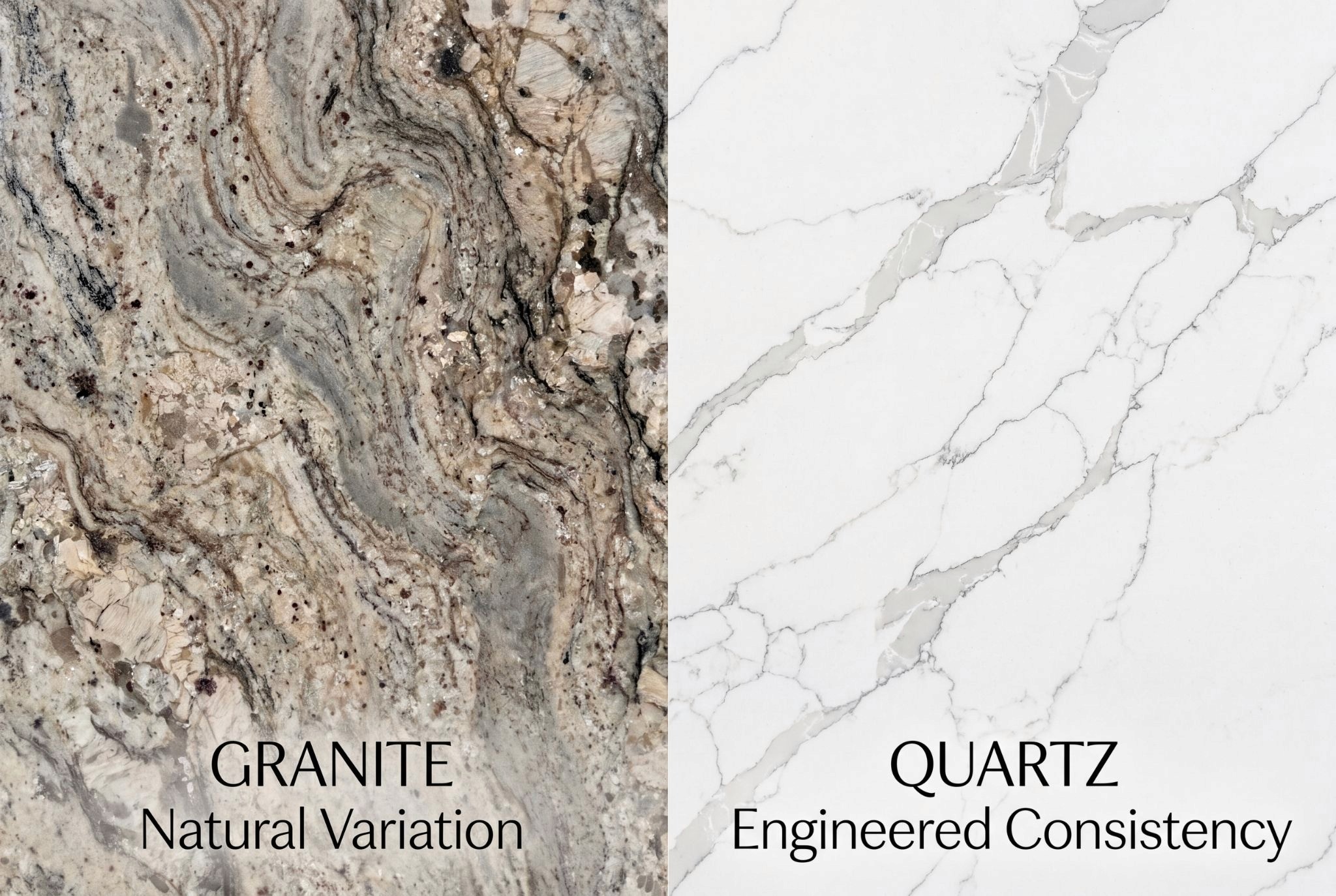
On appearance, granite vs quartz becomes a question of taste rather than performance, and the split is between natural variation and engineered consistency.
Both look excellent installed – they just get there differently.
Granite is one-of-a-kind. Every slab carries its own movement, veining, and mineral flecks, so no two kitchens read quite alike, which is exactly the appeal for homeowners who want natural character.
Quartz is predictable by design. Patterns are controlled and repeatable, the palette runs wider (crisp whites, marble-look veining, deep solids, saturated colors), and slabs match closely across long runs, islands, and future add-ons.
How To Choose Between Quartz vs Granite
Here's how to choose between quartz and granite once you've weighed the factors against your own kitchen. The decision usually sorts itself by how you live and where the counter goes.
You cook seriously and move hot pans often → granite. Its heat tolerance forgives the cast-iron-straight-from-the-oven habit that would scorch quartz.
You want the lowest upkeep, or run a busy family kitchen → quartz. No sealing, strong stain resistance, and a surface that takes daily chaos in stride.
It's an outdoor kitchen or a sun-drenched room → granite. Standard quartz resin can yellow and chalk under sustained UV, so natural stone holds up far better outside.
You want a statement island or genuine natural stone → granite. A dramatic slab makes a natural focal point in a way engineered material rarely matches.
You want consistency across a large kitchen, or matchable add-ons later → quartz. Controlled patterns keep seams, bookmatching, and future expansions predictable.
Plenty Of High-End Kitchens Use Both
Quartz on the main runs for clean consistency, with a bold granite or natural-stone island as the centerpiece.
Whichever way you lean, the slab is one of hundreds of decisions that has to work with your layout, your budget, and how the kitchen gets built. Choosing it in isolation is how you end up with a beautiful material that fights the design or quietly breaks the budget – which is the kind of thing worth lining up before anything is ordered.
Want Your Renovation Handled End-To-End?
Design-led plans, honest budgets, managed materials & coordination through the build.
Quartz vs Granite FAQs
Which lasts longer, quartz or granite?
Both quartz and granite can last 25+ years, so neither has a clear longevity edge in normal use. The deciding factor is care: granite needs periodic sealing, while quartz needs heat protection to avoid resin damage.
Is granite heavier than quartz?
Granite and quartz weigh almost the same – both run roughly 18–24 pounds per square foot at standard thickness. Either one needs sturdy, level cabinetry underneath, which is why support matters more than the material's weight itself.
Does quartz or granite add more value to a home in Palm Beach?
Neither quartz nor granite adds more resale value on its own in higher-end Palm Beach homes, since both read as expected finishes. What moves buyer perception is a current, cohesive kitchen – outdated laminate hurts far more than the stone choice helps.
How can I tell if a countertop is quartz or granite?
You can tell quartz from granite by looking at the pattern: granite shows random, natural flecks and veining that never repeat, while quartz has a more uniform, controlled look. Granite also feels cooler and can be sealed; quartz cannot.
Conclusion
Strip it back and the quartz vs granite call rests on a few honest tradeoffs.
Granite holds up to hot pans, survives outdoors, and gives you a slab nobody else has – at the cost of resealing it every so often. Quartz asks almost nothing of you day to day and keeps its looks consistent across a big kitchen, but it won't forgive a cast-iron pan straight off the burner.
Cost lands close enough that it rarely breaks the tie. What usually does is how you cook and where the counter lives.
If a remodel is where you’re heading, a free discovery call is a low-pressure way to align scope, budget, and a build-ready design from the start – so selections like this one fall into place against a plan instead of in isolation.
Pricing Disclaimer
The pricing figures referenced in this article are derived from an 18-month trailing analysis of projects completed by reputable contractors using quality materials and industry-standard construction practices. These figures are intended for general informational purposes only. Market conditions, material costs, labor rates, and contractor availability can change rapidly, and Palm Club Design Group makes no representation or guarantee that the prices cited reflect current costs or will apply to any future project. Readers should obtain up-to-date quotations from qualified professionals before making any budgeting or planning decisions.


Thinking About a remodel?