Design & Layout
How To Prepare For A Remodel? 9-Step Pre-Construction Guide

The four weeks before construction starts are when smart homeowners do the unglamorous work that decides how the whole project runs.
Materials need confirming. The house needs clearing. Pets, neighbors, permits – all of it needs a plan before the first crew shows up.
Here's the full pre-construction checklist for how to prepare for a remodel, step by step.
Key Notes
Premium materials carry 8–16 week lead times, with 15–20% arriving damaged or out of spec.
Most GCs charge extra to clear furniture, cabinetry, and personal items left in work areas.
Concurrent work like landscaping or pool resurfacing must run through your GC to avoid delays.
1. Confirm Materials Are Ordered, Tracked, And On Schedule
The first thing to verify when preparing for a remodel is that every material selection has been ordered and is actively tracked toward delivery.
Most schedule blowouts on day one trace back to materials, and on a whole-home project, you can be managing 250+ separate orders at once.
Lead Times Are Longer Than You Think
Premium materials carry real lead times:
Custom cabinetry: 8–16 weeks
Imported tile and stone slabs: 8–12 weeks
Specialty plumbing fixtures: 6–10 weeks
Statement lighting: 8–14 weeks
If selections weren't locked in early enough, you'll find out about it right when demolition is supposed to start.
What To Know About The Receiving Side…
A few realities worth planning around:
Roughly 15–20% of design material deliveries arrive damaged, incorrect, or out of spec. That's a planning statistic, not a panic statistic. Inspection has to happen before materials reach the site.
Most suppliers require damage or defect claims within 48 hours of delivery. Miss that window and warranty coverage for shipping damage typically voids.
Confirm in writing who owns receiving and inspection. Between you, your designer, and your GC – ambiguity here gets expensive.
Photos at delivery protect you later. Simple, fast, and useful when items go missing or get damaged on site.
This is one of the reasons the Palm Club process runs material procurement through Palm Club Logistics – orders, receiving, inspection, defect resolution, and documentation are all handled by a single team.
Most of the time, the homeowner never even knows there was an issue with a delivery.

2. Clear The Work Areas Yourself
Clearing the work areas is the cheapest and most undervalued step in preparing for home remodeling. Most GCs will charge additional fees for removing furniture, art, and personal items that weren't cleared before crews arrived.
It's an avoidable line item, and the work itself is straightforward.

3. Plan Where Your Belongings Will Live
Where your stuff goes during construction is one of those decisions homeowners consistently underestimate, and one of the most useful home remodel tips is to plan storage capacity for at least 110% of what you think you'll need.
The contents of a fully furnished home take up more space than people expect.
Anything Valuable, Fragile, Or Sentimental Should Leave The Property
Even well-run job sites are dusty, unpredictable, and accessed by multiple trades over a long stretch of time. The math on protecting irreplaceable items is simple.
A few options worth considering:
Storage Option | Best For | Watch Out For |
Climate-controlled storage unit | Most situations in South Florida – humidity, mildew, and heat damage are real | Access logistics; book early during peak season |
Portable on-site pod | Shorter projects where you'll need access | Takes driveway space the contractor may need |
Second home or family property | Items that need to stay close | Coordination of multiple trips |
Two Practical Notes That Pay Off Later:
Photograph and inventory anything you store – it's useful for insurance and useful when it's time to move back in.
Label boxes by the room they're going to, not the room they came from. After three months in storage, future-you will not remember what was in the "main bedroom closet" box.
One Specific Warning:
Avoid using the garage as long-term storage.
Your GC will almost certainly need it for staging construction materials, tools, and equipment, and competing for that space mid-project is a fight nobody wants.

4. Decide Whether You're Moving Out During The Remodel
For any significant remodel, plan to leave the property.
Even the best-run job sites are noisy, dusty, and chaotic from the outside. Staying through it puts stress on the family and slows down the contractor, who needs unrestricted site access to keep the schedule moving.
When To Move Out
Plan to relocate for any of the following:
Whole-home remodels
Full kitchen renovations
Primary suite renovations
Multi-room scopes running concurrently
Where To Stay
Common options:
Short-term rental (Airbnb, VRBO)
Extended-stay hotel
Second home if you have one
Family or friends for shorter stays
Book accommodations early and build in buffer.
Remodels run long more often than they run short. A 12-week project that becomes 16 weeks shouldn't force you back into an active construction zone.
If You're Staying In The House
For smaller, contained remodels (one bathroom, a single room) staying may be feasible.
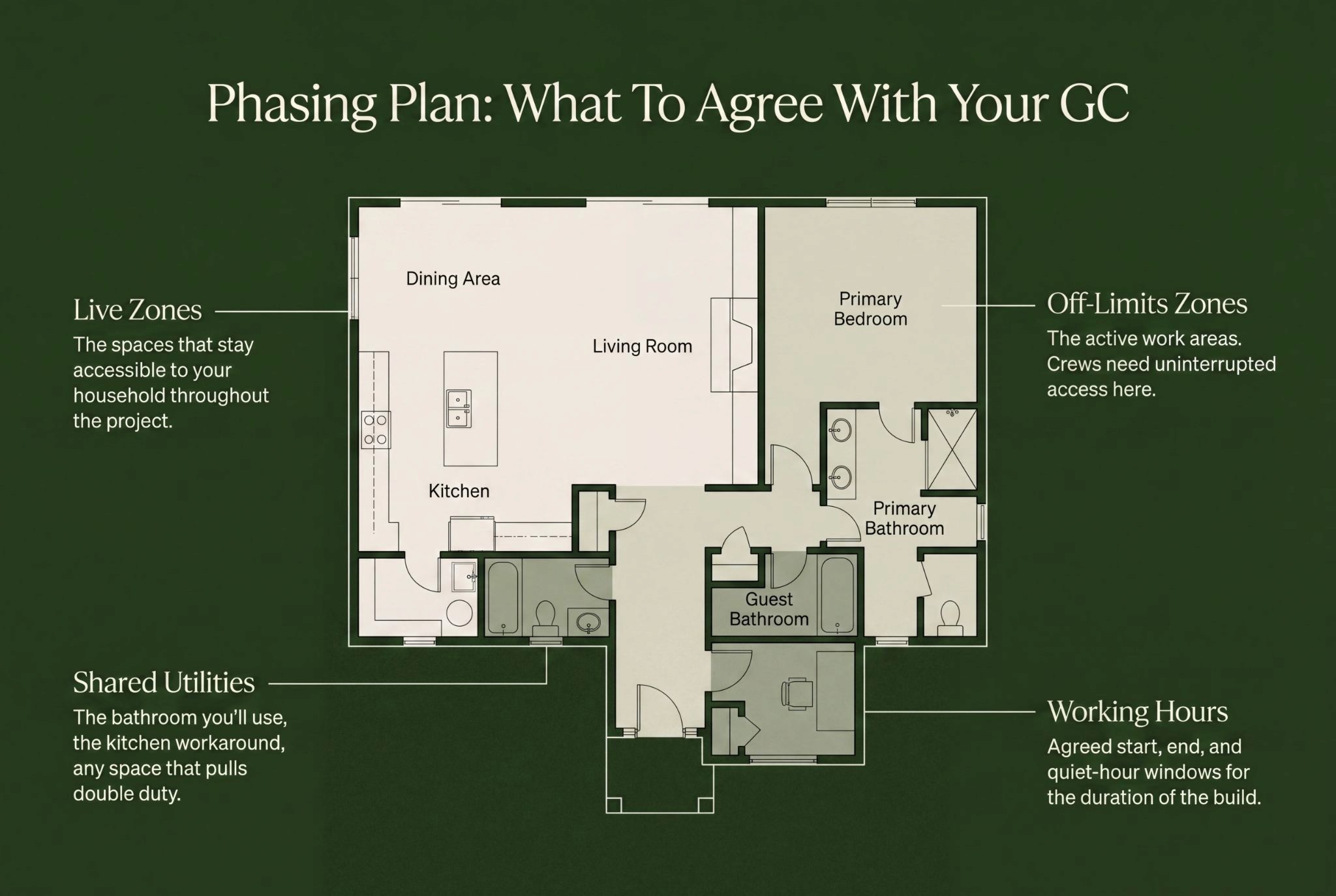
Put it in writing. It avoids the mid-project conversation where everyone remembers it differently.
Setting Up A Temporary Kitchen
For homeowners preparing for a kitchen remodel and staying in the house, set up a temporary kitchen elsewhere.
The essentials:
Microwave
Electric kettle
Mini-fridge
Paper plates and disposable utensils
A defined surface for prep
Six weeks of takeout sounds fun for about a week.

5. Make Arrangements For Pets
Arranging care for pets is one of the more important steps in preparing for a remodel.
Why Pets & Job Sites Don't Mix
A few things working against any pet left near an active remodel:
Open doors and unfamiliar trades coming and going
Power tools and constant noise
Dust and airborne debris
Construction materials that are toxic to animals
Where Pets Can Go
The options are familiar:
A family member or friend's home
A trusted boarding facility
Wherever you're staying for the duration of the project
Whatever you choose, sort it out before the first crew arrives.
Budget For It Upfront
Build the cost of pet boarding into your overall renovation budget. It's a real number, and it's the one homeowners forget until it arrives.
6. Give Your Neighbors A Heads-Up
A remodel disrupts neighbors more than it disrupts the homeowner who's moved out.
Construction noise, contractor vehicles, blocked street parking, dumpsters, and 7am start times all land on people who didn't sign up for any of it. A short conversation, a written note, or a well-placed bottle of wine buys a meaningful amount of goodwill.
What To Cover In The Conversation
Useful things to mention upfront:
Estimated project duration (the honest range, not the optimistic one)
Expected working hours (when crews typically arrive and leave)
Logistics that might affect them (street parking, dumpster placement, large material deliveries)
A direct way to reach you if something becomes an issue
The Property Value Angle
It's also worth mentioning that a well-executed remodel tends to lift surrounding property values. Neighbors generally appreciate hearing that.
For Gated Communities & HOAs
If you're in a managed community, confirm the following before construction starts:
Contractor approval requirements
Working-hour restrictions
Parking rules for crews and trade vehicles
Dumpster permits and placement rules

7. Coordinate Concurrent Work Through Your GC
It's tempting to use the remodel as cover to get other work done.
Coordinating those contractors independently is one of the most reliable ways to introduce delays, because it creates accountability gaps that nobody owns.
The Work Homeowners Try To Sneak In
The usual suspects:
Landscaping and garden redesign
Pool resurfacing or equipment upgrades
Exterior painting
Driveway repaving or sealing
Roof work or gutter replacement
Why It Has To Go Through The GC
Any additional work during the construction period should be discussed and coordinated with your GC first. Even if they're not running it, they need to know it's happening so they can plan around it.
Coordinating through the GC protects:
Site access for trades and deliveries
Parking for crews and material trucks
Utility shutoffs that affect both projects
Dumpster scheduling and waste removal
The construction sequence itself
None of it works well when surprise crews show up.

8. Confirm Permits & The Start Date
The last technical thing to verify before construction begins is that permits are issued or imminent. Permits are the GC's responsibility (handled through their licensed architect or engineer) but the timeline affects you directly.
Permit Timelines Vary By County
In South Florida, the timeline depends entirely on the jurisdiction:
Palm Beach County
Martin County
St. Lucie County
Each runs different processes, and pulling permits can take anywhere from a few weeks to a few months depending on scope and review backlog.
A Start Date Is Meaningful Only When Permits Are In Hand
Before you finalize the rest of your pre-construction logistics, confirm with your GC that approvals are issued or imminent.
That includes:
Move-out dates
Storage rental agreements
Pet boarding reservations
Accommodation bookings
Build A Buffer Into The Schedule
Add a week or two of margin between the confirmed start date and your move-out date. It's cheap insurance compared to the cost of rebooking everything when permits run late.

9. Align On Communication Before Day One
The final piece of pre-construction prep is agreeing on how you and the team will communicate once construction is live.
Three Things To Settle Before Day One
1. Update cadence
Tell the team upfront what works for you:
Weekly summary emails
Milestone-based check-ins
Daily text updates with photos
Some homeowners want to see every tile go in. Others just want to be told when the next decision is needed.
Either works – leaving it unspoken doesn't.
2. Single point of contact
Confirm who you'll be talking to day to day. One name, one number, one inbox.
Getting conflicting information from three different sources is one of the fastest ways to lose confidence in a project.
3. Change order process
Confirm in writing that any change to scope or materials will be:
Documented
Priced
Approved before any additional work proceeds
No verbal "we'll sort it out at the end" arrangements.
For Remote & Second-Home Owners
For homeowners managing the project remotely (second-home owners up north, out-of-state investors, anyone not physically nearby) this conversation matters more.
Lock the communication structure down before the first crew shows up.
Renovating Soon & Want It Done Right?
Get a design-led plan, a contractor we work with regularly & a partner who stays involved.
How To Prepare For A Remodel FAQs
How long before a remodel should I start preparing?
Start preparing for a remodel at least 4–6 weeks before construction begins. Material lead times, storage logistics, accommodation bookings, and permit approvals all need that runway to line up cleanly.
What should you not do before a remodel?
Don't lock in your move-out date, storage rental, or pet boarding before permits are confirmed. Permitting timelines vary by county and frequently slip – committing to the rest of your logistics first is one of the most common ways homeowners lose deposits and rebook everything twice.
How do you protect your floors during a remodel?
To protect floors during a remodel, your GC should lay down ram board, builder's paper, or adhesive plastic film across all walkways and adjacent rooms the crew will access. Confirm floor protection is included in the contract – it's a small line item that prevents thousands in refinishing costs.
Do I need to empty my kitchen before a remodel?
Yes, empty your entire kitchen before a remodel starts, including upper cabinets, lower cabinets, pantries, drawers, and anything on top of the cabinets. Most contractors charge extra to remove these items themselves, and clearing it yourself protects fragile dishware from dust and demolition impact.
Conclusion
The four weeks before construction are almost entirely admin. They're also the weeks that separate the remodels that finish on time from the ones that don't.
Knowing how to prepare for a remodel is really about sequencing – materials confirmed and inspected, work areas emptied, belongings stored offsite, the household relocated, neighbors looped in, concurrent work coordinated, permits in hand, and a clear agreement on how the team will talk to you once things go live.
Each item removes a category of risk that costs real money when it shows up mid-project.
If you'd like a design-led team in your corner before construction begins – handling scope, vetted contractor proposals, materials, and oversight on your behalf – book a free discovery call and we'll talk through your project.


Thinking About a remodel?